



A Flemish gable is not just a roof shape, it’s a bit of architectural drama sitting on top of a building like it owns the skyline. You look up and instead of a plain triangular gable, you see curves, scrolls, little flourishes that feel almost theatrical. It’s part triangle, part ornament, part “why is this roof showing off?”
Technically speaking, a gable is the triangular portion of wall between the edges of a pitched roof. But a Flemish gable modifies that triangle with stepped or curved outlines, often crowned with decorative stonework. It emerged during the Renaissance architecture period in the Low Countries, especially in what is now Belgium and the Netherlands. That’s the polite textbook answer.
But if you’ve ever stood in Bruges or wandered around Antwerp, you’d know it feels less like a definition and more like a mood. The skyline looks like a row of iced cakes. I mean that in a good way. Frosted brick, carved stone, bold silhouettes.
Origins in the Low Countries
The Flemish gable took shape in the 16th and 17th centuries. During the Dutch Golden Age, urban centers like Ghent and Brussels were expanding rapidly. Trade was booming. Merchant houses needed to look respectable, prosperous, maybe even a bit competitive. And instead of building wider, which city plots rarely allowed, builders went vertical.
Statistics from historical urban surveys show that in cities like Amsterdam, more than 70 percent of canal houses built during the 17th century featured some form of decorative gable. Not all were Flemish style, but the decorative impulse was everywhere. Step gables, bell gables, neck gables. The Flemish gable sat comfortably among them, slightly more ornate, slightly more confident.
Brick was abundant in the Low Countries. Timber framing was common earlier, but brick construction became dominant. And brick plus carved sandstone equals personality. Builders layered the façade upward, adding scroll-shaped volutes along the sides. It wasn’t necessary structurally. That’s the funny part. It was style. Pure façade bravado.
How It Differs from a Standard Gable
A standard gable is straightforward. Two roof slopes meet at a ridge. Triangle below. Done. Nothing fancy. It’s the bread and butter of rooflines.
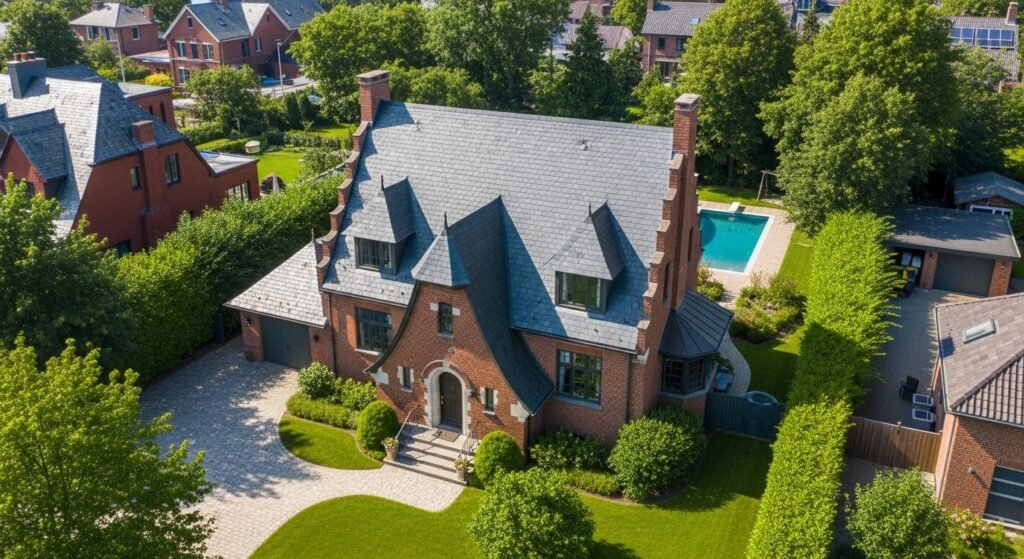
A Flemish gable, on the other hand, interrupts that triangle. Instead of straight lines, the sides curve inward and outward in ornamental shapes. Sometimes you see stepped profiles, other times smooth S-shaped scrolls. Often topped with a small pediment or finial.
The key difference lies in ornamentation. A Flemish gable is essentially a façade feature attached to the end of a pitched roof. Structurally the roof might be ordinary behind it. The gable is a decorative mask, almost theatrical, hiding the plain roofline behind it.
I once thought these curves meant some clever rainwater trick. Turns out, not really. It’s mostly aesthetics. Architects in the Renaissance period were heavily influenced by classical forms from Italy, and they adapted those ideas into local brick traditions. So you get classical scrolls rendered in northern masonry. A cultural remix, centuries before that word existed.
Flemish Gable vs Dutch Step Gable
People often confuse the Flemish gable with the Dutch step gable. I did too, honestly. They both look decorative and tall and slightly dramatic.
The step gable has a staircase-like outline climbing upward. Clean, geometric, almost Lego-like. The Flemish gable leans into curves and volutes, borrowing from classical scroll motifs. It feels softer, more ornamental.
During the 17th century, building regulations in some Dutch cities even specified façade alignments and heights, but they did not strictly limit decorative styles. So you’d see entire rows of canal houses, each with its own personality. Urban competition via brick. That’s my theory anyway.
Architectural Context and Spread
The Flemish gable didn’t stay confined to Belgium or the Netherlands. As trade networks expanded across Europe, so did architectural ideas. You’ll find Flemish-influenced gables in parts of northern France, Germany, and even in colonial architecture abroad.
In England, elements of Dutch Renaissance architecture influenced buildings during the late Tudor and early Stuart periods. Decorative gables appeared in some manor houses and townhouses, though often simplified.
In the United States, during the 19th century revival movements, architects looked backward for inspiration. The Dutch Colonial Revival style occasionally echoed stepped and decorative gables, though true Flemish scroll forms were less common. Still, the idea of a sculpted roofline persisted.
Globally, more than 40 percent of European historic urban centers protected under cultural heritage programs include examples of decorative gables. Not all are Flemish, but the category of ornate gable architecture is substantial. The roof became a branding device long before logos were invented.
Construction Details That Matter
Now, structurally, the Flemish gable is typically built as an extension of the façade wall. The underlying roof may be timber-framed. The decorative gable is often masonry, rising above the roofline and concealing it from the street view.
This has implications. Wind loads act differently on ornate shapes. Curved edges can create pressure differentials. In coastal regions of the Low Countries, buildings had to withstand North Sea storms. Brick thickness and bonding patterns were crucial. Flemish bond brickwork, interestingly, alternates headers and stretchers, adding both structural stability and visual texture.
I once read that brick façades in 17th century Amsterdam were sometimes over 30 centimeters thick at the base. That’s not flimsy decoration. That’s mass. The decorative top, though lighter, was still substantial.
And maintenance. Oh, maintenance. Carved stone volutes erode over centuries. Freeze-thaw cycles cause cracking. Restoration projects in cities like Brussels allocate significant budgets annually to façade conservation. It’s beautiful, yes, but it asks for care.
Why It Still Captures Attention
There’s something stubbornly charming about a Flemish gable. Maybe it’s the way it refuses to be a straight line. Architecture can be very rigid, very grid-based. Then this roofline curls like it’s shrugging at geometry.
Modern architects occasionally reinterpret it in contemporary materials. Concrete, steel, even minimalist versions. Though sometimes, if I’m honest, the modern versions feel too clean. The old ones had soot, weathering, uneven brick tones. Personality lives in imperfection.
In heritage tourism data across Belgium and the Netherlands, historic city centers with preserved gabled façades report significantly higher visitor numbers compared to areas without concentrated historic architecture. Architecture drives economy, not just aesthetics. Rooflines matter.
Cultural Symbolism and Identity
The Flemish gable became a symbol of prosperity during the 16th and 17th centuries. Merchant wealth expressed itself upward. The façade became a statement. In crowded urban environments, where plot widths were narrow, vertical embellishment signaled status.
It also reflected regional identity. The Low Countries were not copying Italy blindly. They were adapting Renaissance motifs to brick-heavy construction traditions. That synthesis created something distinct.
When you stand before a row of gabled houses along a canal, you sense continuity. A skyline shaped not by accident but by shared aesthetic ambition. It’s almost like the buildings are leaning forward, eavesdropping on the street below.
Final Thoughts That Aren’t Really Final
So what is a Flemish gable? Technically, a decorative, often curved gable façade emerging from Renaissance-era Flanders. But that sounds too neat.
It’s ornament perched on structure. It’s brick showing off. It’s merchants competing with masonry. It’s scrolls carved into skyline.
And maybe, just maybe, it’s proof that even something as practical as a roof can decide to flirt with the clouds a little.

Jane Thompson is a seasoned journalist covering local and national news with a focus on community impact and civic issues. With over a decade of reporting experience, Jane brings clarity, depth, and factual insight to every story she writes. Outside of work she enjoys mentoring young writers and exploring the intersection of journalism and civic engagement.