

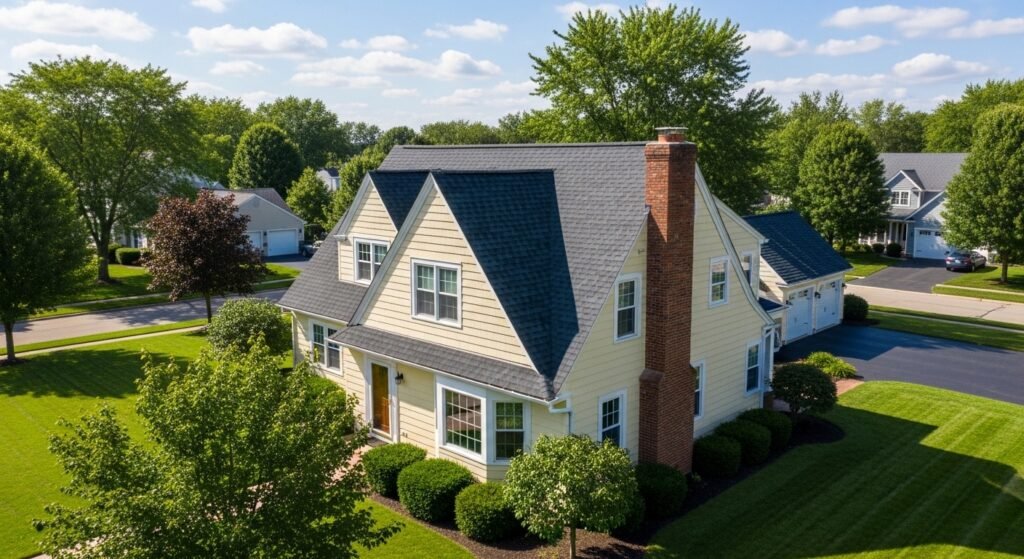
You have probably seen a snub gable roof and not even noticed it, which feels unfair to the roof honestly. It just sits there, half-serious, half-rebellious, like it started life as a full gable roof and then someone said, you know what, let’s just trim the top and call it a day.
And that’s sort of what it is. But also not that simple. Roofs never are.
So What Exactly Is a Snub Gable Roof?
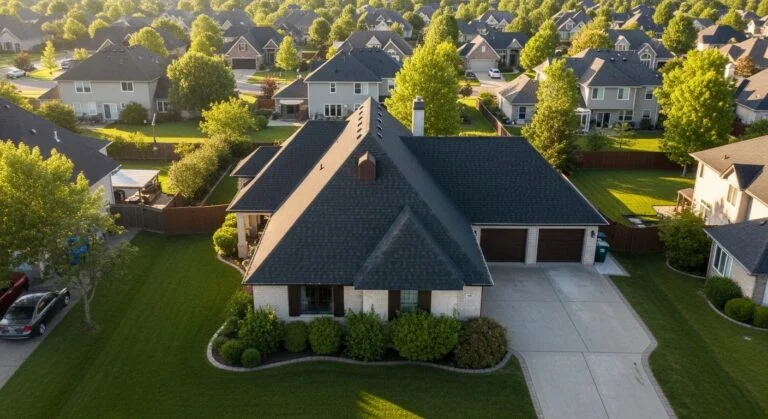
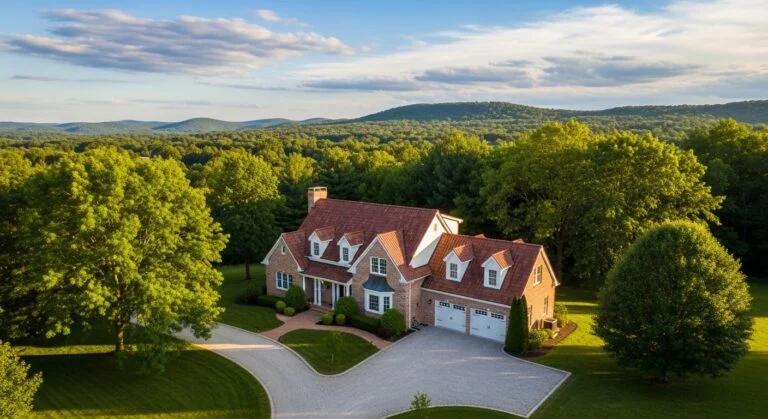
A snub gable roof is basically a gable roof whose peak has been cut short and replaced with a small hipped section at the very top. Instead of two roof planes meeting in a sharp ridge that runs all the way across, the ridge stops early. The very top is sloped on all sides, forming a little hip. It looks like the roof’s nose was gently pressed in. Snub. Cropped. Trimmed.
Architects sometimes call it a clipped gable or jerkinhead roof. Same family, slightly different accents. In older Colonial Revival homes and some Craftsman houses, this shape pops up quietly, not loud but definitely intentional.
It is not trying to be dramatic. It is trying to survive wind.
A Quick Visual Breakdown
You can see the difference if you squint a bit. The normal gable goes straight up to a point. The snub gable kind of… hesitates. And then slopes back.
Why Would Anyone Cut the Top Off a Gable?
Wind. Mostly wind.
Traditional gable roofs are simple and efficient. Two sloping sides, triangular ends, easy framing, lower labor costs. But those flat vertical ends, called gable ends, catch wind like a sail. In high wind zones, that can be a problem. According to FEMA and various building code studies after major hurricanes in the U.S., gable ends are one of the most vulnerable parts of a roof during storms. In hurricane-prone states, insurance data has repeatedly shown higher failure rates at unsupported gable end walls.
Now here comes the snub gable, trying to be clever.
By clipping the top and introducing a small hip roof section, wind pressure at the peak reduces. The wind has less flat surface to slam into. Structural engineers often note that hip roofs perform better under uplift forces because the slopes deflect wind rather than stopping it bluntly.
So the snub gable becomes a compromise. You keep most of the attic space and classic look of a gable, but you borrow some wind resistance from a hip. It is like mixing practicality with stubborn tradition. I respect that.
Framing and Structural Behavior
This is where it gets mildly technical, so hang in there.
A full gable roof transfers loads down through the ridge and rafters to the exterior walls. The triangular end wall needs bracing, especially in areas with strong lateral loads. In contrast, a hip roof distributes loads more evenly along all exterior walls because every side slopes down.
The snub gable adds short hip rafters at the clipped section. This reduces the height of the unsupported gable end wall. That shorter wall equals less leverage for wind forces to exploit. Less leverage usually means less dramatic structural failure. And contractors sleep slightly better at night.
In coastal regions of the southeastern United States, building codes influenced by the International Residential Code often recommend additional bracing for gable ends. Some builders opt for clipped gables as a design-plus-performance compromise. It is not mandatory everywhere, but it is common.
I once stood under one during a windy afternoon and thought, this roof looks calmer than it should. That is not science. Just a feeling.
Aesthetic Appeal, Because Let’s Be Honest
It looks interesting.
A pure gable can be a bit too sharp, too storybook. A hip roof sometimes feels heavy. The snub gable roof breaks the silhouette in a subtle way. That small angled cap at the top adds character without screaming about it.
In certain Dutch Colonial or early 20th-century American homes, clipped gables show up as a quiet detail that architects slipped in almost mischievously. You notice it only after someone points it out. Then you cannot unsee it.
It gives the house a slightly softened crown. Like someone ran their hand over the peak and said, let’s round this thought off.
Cost Implications and Construction Realities
Here is the slightly less romantic part.
A standard gable roof is among the most cost-effective roof designs. Fewer planes. Simpler framing. Less labor time. According to general construction cost comparisons, hip roofs can cost 5 to 10 percent more than equivalent gables because of increased framing complexity and material use.
A snub gable roof sits somewhere in between. It adds complexity but not as much as a full hip. You introduce additional cuts, additional framing joints, slightly more labor hours. For a custom home, this difference is usually marginal relative to total build cost. For production builders working on tight margins, even small differences matter.
Roofers sometimes grumble about the transitions. More flashing details. More attention required where planes meet. Not dramatic, just more thinking involved.
And thinking costs money. Or at least time.
Performance in Snow and Rain
Water does not care about your design preferences. It flows where gravity tells it to go.
In heavy snow regions, a gable roof sheds snow fairly predictably down two sides. A hip roof sheds snow on all four sides. A snub gable introduces additional junctions where snow can drift slightly differently near the clipped portion.
However, because it retains mostly gable geometry, snow load distribution remains similar to a traditional gable in many cases. The small hip at the top does not dramatically alter overall load patterns. Proper roof pitch still matters more. A steeper slope reduces snow accumulation regardless of whether the peak is clipped.
For rain, drainage is generally efficient. The small hip does not create large valleys like more complex roof systems do. That is good. Valleys are notorious leak points if not detailed correctly.
Less valley equals fewer future headaches. Usually.
Attic Space and Interior Impacts
This part often gets overlooked.
A full gable maximizes usable attic volume because the ridge runs straight across. A hip roof reduces attic headroom near the edges due to inward sloping sides. The snub gable reduces attic volume only slightly at the clipped portion. For homeowners wanting storage or potential attic conversion, that small difference rarely becomes a dealbreaker.
You still get the triangular volume that makes attic insulation straightforward. And speaking of insulation, in U.S. homes, attic insulation levels often aim for R-30 to R-60 depending on climate zone. The snub gable does not complicate insulation strategy in any meaningful way compared to a normal gable.
It behaves like a gable. Just with a haircut.
Where You’re Most Likely to See It
You might find snub gable roofs in:
- Coastal areas with moderate hurricane exposure
- Early 1900s American residential neighborhoods
- Some modern custom homes that want a twist without going full experimental
They are less common in strictly minimalist contemporary architecture. Those homes tend to prefer flat or shed roofs. The snub gable belongs more to traditional or transitional design languages. It whispers heritage.
Is It Better Than a Regular Gable?
Better is a slippery word.
If you live in a high-wind zone, and you are comparing purely on wind resistance, a full hip roof generally performs best. Studies of post-hurricane damage have consistently shown lower failure rates in hip roofs compared to gable roofs when built to similar standards.
But if you care about cost, simplicity, and classic aesthetics, a standard gable still wins in many markets.
The snub gable roof stands in the middle. It is the compromise child. Not as wind-efficient as a full hip, not as simple as a full gable, but trying to blend both virtues. Sometimes compromise is smart. Sometimes it just makes architects feel clever. Depends who you ask.
Final Thoughts, Slightly Messy On Purpose
The first time you notice a snub gable roof, you might shrug. The second time, you tilt your head. By the third time, you start scanning neighborhoods for them like a roof detective. It becomes oddly addictive.
It is not flashy. It does not shout. It is a small adjustment to a familiar form. And yet, small adjustments in architecture often carry weight beyond their size. Wind load, structural behavior, cost trade-offs, visual nuance. All sitting quietly in that clipped peak.
So next time you look up at a house and the roofline feels a bit… restrained, maybe that is your answer. A snub gable. Cropped, practical, slightly stubborn. And honestly, kind of brilliant in its own quiet way.

Natalie Brooks champions sustainable remodeling and smart home upgrades that boost comfort and efficiency. She writes about eco-friendly materials, energy-saving remodel ideas, and integrating modern technology into traditional spaces. Natalie also consults with homeowners on greener renovation decisions and enjoys testing new smart home gadgets.